
Oil Analysis
Oil Testing and Analysis
We provide five accurate tests for chillers.
Water (by the Karl Fischer method)
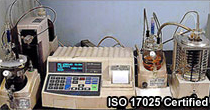
This is a highly accurate, precise, and objective method for determining total water contamination present in a fluid, whether the water is suspended, dissolved, or emulsified. A co-distillation used with this test method eliminates interference affected by the presence of sulfur containing additives such as anti-wear agents and rust-inhibitors. Water rusts iron and steel surfaces, accelerates corrosion, depletes and degrades additives, promotes base oil oxidation, and reduces lubricant effectiveness. Large amounts of water can form sludge and free water may cause the formation of hard brittle deposits on bearing surfaces and promote bacteria growth. All of these factors can impair machine reliability.
Spectrochemical Analysis
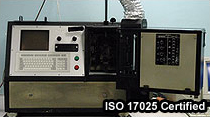
This test determines the concentration of elements represented in the entrained fluid sample by emission spectroscopy. These metals indicate wear on particular components of an individual unit. The particles of these metals will indicate a wear problem on the microscopic level before the problem can be detected by conventional means. The existence of a wear problem is determined not only by absolute values of metals, but more importantly by a relative increase or trend in one or more metals.
Viscosity
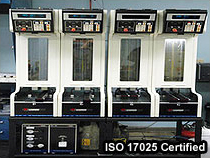
Viscosity is the measurement of internal friction, or a fluid’s resistance to flow, under gravitational forces. Viscosity affects equipment operation, friction losses, and oil film thickness on bearings. Its measurement and trending is critical to used oil analysis. Even modest changes in viscosity may adversely influence the lubricant’s performance and stability, possibly causing metal-to-metal contact and wear. Change in a lubricant’s viscosity is a common symptom of a host of other problems, such as excessive contamination (from water, glycol, fuel, solvents, and/or very small particles), chemical degradation, severe mechanical shearing of the oil, or mixing with incompatible fluids. Other units of measurement, such as SAE grade, are related to a fluid’s viscosity. Since viscosity varies inversely with temperature, its value is meaningless until the temperature at which it is reported.
Acid Number
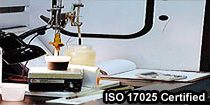
Formerly known as Total Acid Number, this is a measure of acidic constituents present in a fluid. As oil ages and oxidizes, small amounts of acidic by-products are formed in the oil causing the acid number to increase. A high acid number typically indicates that the oil’s useful life has expired and needs to be changed. Water contamination in highly acidic fluids strengthens the corrosive potential of acids, resulting in a highly corrosive fluid capable of aggressively attacking bearing materials and other surfaces.
Total Solids
Particles of carbon or agglomerates of carbon and other material can indicate deposition or dispersant additive or particulate drop-out in a component. A rapid increase in these particles indicates a serious situation which must be addressed through appropriate unit maintenance or fluid replacement.